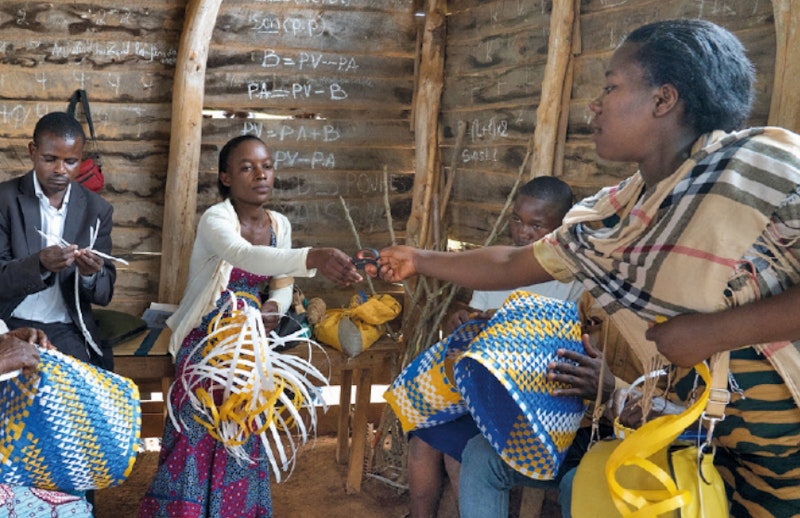
Social Action

What kinds of activities are Bahá’ís involved in for the benefit of others?

The life of a Bahá'í is dedicated to personal and social transformation. Bahá'u'lláh explained that transformation is the true purpose of religion, and He described the personal and social processes as essentially interactive and complementary. Consequently, Bahá'ís are committed to building the capacity of individuals and to learning, through community-based efforts, how better to effect change and improve society. The empowerment of individuals and the fostering of their initiative are thus basic elements of social and economic development processes in fields such as education, agriculture, and health improvement. These efforts are animated by Bahá’u’lláh’s call for the unity of humankind, the fundamental objectives of which include eliminating racial and other forms of prejudice, promulgating the equality of the sexes, adopting a universal standard of human rights, ensuring education for all, recognizing the harmony between religion and science, choosing an international auxiliary language, and establishing a world government. Bahá’ís join others in such endeavors, creating and cooperating with relevant nongovernmental organizations, including at the United Nations where the Bahá’í International Community is an active nongovernmental organization. More >

What is the vision for the future?

Bahá’ís’ vision of the future derives from a fundamental understanding that human beings have been created to “carry forward an ever-advancing civilization.” This advancement is impelled by the coming of the Messengers of God from age to age. Bahá’u’lláh proclaimed that the time has arrived for humanity in all its diversity to realize its potential to live as one united people, empowered through His Revelation to establish a world civilization based on justice and peace. More >

How do Bahá’ís relate to politics?

Bahá’ís take their civic responsibilities seriously and uphold the authority of established governments through loyalty and obedience to the laws of their country. While participating in elections for their government, they abstain from partisanship, and so do not join political parties or factions. Bahá’ís may serve their government in administrative posts but do not accept political appointments or run for elected office. Such service reflects the practice within the Bahá’í community, which holds elections for its administrative councils that are entirely without nominations or campaigning. More >

Do Bahá’ís suffer persecution?

The earliest followers of Bahá’u’lláh and of His Forerunner, the Báb, met brutal opposition incited by the clergy and were killed in the thousands. Today, the Bahá’í Faith still suffers severe repression in Iran, the land of its birth, and in several other Muslim countries. The 300,000 Bahá’ís in Iran constitute its largest religious minority, and in recent years many have been killed, imprisoned, and deprived of employment and education solely because of their religious beliefs. Bahá’ís have also been persecuted under fascist and communist regimes. More >

What is the source of problems in today’s world?

Bahá’ís see, in the accelerating turmoil unsettling every department of life, the operation of two simultaneous processes: namely, the death pangs of an old order no longer capable of meeting the requirements of present-day society and the birth pangs of a new order as indicated by the trend towards global cooperation—a trend gathering momentum from a flood of new knowledge and rapid advances in the fields of science, technology, and the arts, which have made of the world an accessible neighborhood. It is evident that a regenerating force is at work throughout the planet, but humanity as a whole has not yet recognized the reality of it as explained by Bahá’u’lláh. This lack of recognition prolongs, and delays the solutions for, the problems of our time. More >

What is the Bahá’í position on the status of women?

The Bahá’í writings clearly indicate that, from the spiritual point of view, there is no difference between women and men and no basis—moral, biological, or social—for discrimination on grounds of gender. Consequently, an essential equality of rights and opportunities between the two is upheld and promoted. More >

How do Bahá’ís view the environmental crisis?

Bahá’ís see the environmental crisis as one of a number of issues requiring a profound change in human behavior. They believe that humanity is in a turbulent period of transition towards a unified global society. Humanity will be able to live in harmony with the natural environment when its spiritual and material potentials are given balanced attention. More >

What is the Bahá’í view of human rights?

Human rights are the birthright of every person and must be applied to all according to a universal standard. For Bahá’ís these rights derive from the emphasis in Bahá’u’lláh’s writings on justice for a world society dedicated to achieving the unity of the human race by recognizing the indispensability of equal rights for all. At the individual level these rights are reinforced by the Bahá’í teaching that one should be fair to one’s self and to others. More >

What is the Bahá’í attitude toward poverty?

Bahá’u’lláh taught that extremes of wealth and poverty are not conducive to a just society and must be eliminated. Bahá’ís understand that with the development of a proper culture of work as service to humankind, supported by such means as just governance and universal education, the problem of poverty will be resolved. More >

What is the Bahá’í concept of work?

Bahá’ís believe that work performed in the spirit of service to humanity is a form of worship. All Bahá’ís are enjoined to engage in trades, crafts, or professions to earn livelihoods and serve their community. More >

What is the Bahá’í attitude towards science and technological progress?

Bahá’ís view science and religion as two complementary systems of knowledge, which throughout history have been the most powerful instruments for the investigation of reality and the advancement of civilization. Bahá’ís see the harmonious interaction of science and religion, each operating within its proper sphere, as one of the prerequisites for the establishment of a peaceful and just society. More >

General Information
The Bahá'ís
The home page of the Bahá'í International Community Web site.
Bahá'í Topics
Concise summaries of Bahá'í history and belief, and information about the worldwide Bahá'í community.
The Life of Bahá’u’lláh
A photographic narrative about the life of the founder of the Bahá’í Faith.
Bahá’u’lláh
Writings of Bahá’u’lláh and a history of His life, His teachings, His station.
Reference
Bahá'í Reference Library
The Bahá'í sacred writings available online.
Bahá'í Statement Library
Statements issued by the United Nations office of the Bahá'í International Community.
Bahá'í Media Bank
Photographs available for downloading.
News
Bahá'í World News Service
News from around the globe.
One Country
The quarterly newsletter of the Bahá'í International Community, with in-depth features, book reviews and commentary.
Bahá'ís of Iran
News reports on the persecution of Bahá'ís by the government of Iran.
Bahá'ís of Egypt
Updates on human rights abuses suffered by Bahá'ís in Egypt.