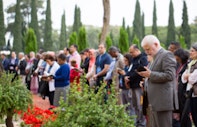
The Oneness of Religion: the Bahá'í Faith and the Interfaith Movement
More than a century ago, Bahá'u'lláh told Bahá'ís to "Consort with the followers of all religions in a spirit of friendliness and fellowship." Bahá'u'lláh's teachings on religious unity are clear and unambiguous: religion is one, all religions spring from the same Divine Source.
In accordance with that principle, the worldwide Bahá'í community has, since its earliest days, articulated in interfaith activities religion's essential unity, thereby working to promote harmony among the world's faiths and their followers.
Founded in 1844 in Iran, the Bahá'í Faith is today the second-most widespread independent world religion, according to the Encyclopedia Britannica. With its teachings on human and religious oneness, it has attracted followers from every religious, ethnic, racial and national background. Currently, there are some five million Bahá'ís, residing in virtually every country and territory.
The growth and expansion of the Faith paralleled the rise of the international interfaith movement, a relatively new phenomenon. Before the middle of the last century, the world's major religions had little contact with each other, outside of war and conflict.
But the first wave of globalization in the mid-1800s - powered by the steamship, the railroad and the telegraph - brought believers of all religions into increasing contact, and many began to see the importance of inter-religious understanding. A perception grew among students and commentators that religions shared underlying similarities.
A milestone came in 1893, when the World's Parliament of Religions in Chicago, drew "together the widest spectrum of speakers and participants ever assembled from the religious traditions of the world," according to Diana Eck, a professor of comparative religion at Harvard University. While the representation was overwhelmingly Christian, with some 100 of the 170 speakers identified as Protestant, also present on the podium were Muslims, Buddhists, Hindus, Confucians, Jains and Zoroastrians.
For Bahá'ís, the Parliament has a special significance: it was the first time the Bahá'í Faith was publicly mentioned in the Western world - and it symbolized in many ways the dawning of the ideal of inter-religious harmony that Bahá'ís work for.
Although Bahá'u'lláh was the object of intense religious persecution and spent much of His adult life as a prisoner of the Ottoman Empire, He nevertheless associated with religious leaders and followers of all kinds - as evidenced by the great outpouring of sentiment that followed His passing in Palestine in 1892.
"Notables, among whom were numbered Shí'ahs, Sunnís, Christians, Jews and Druzes, as well as poets, 'ulamás and government officials, all joined in lamenting the loss, and in magnifying the virtues and greatness of Bahá'u'lláh, many of them paying to Him their written tributes, in verse and in prose, in both Arabic and Turkish," writes Shoghi Effendi in "God Passes By", an authoritative account of the Bahá'í Faith's first century.
At the end of the 19th century, there were some 50,000 Bahá'ís in the world. The Faith had spread to most of the countries and territories in the Middle East and to the Indian subcontinent. In Europe, the Americas, sub-Saharan Africa, Australasia, and most of Asia, Bahá'u'lláh and His teachings were yet largely unknown.
This changed when His son, 'Abdu'l-Bahá, made a landmark tour in 1911 and 1912 of Europe and North America. During that tour, the Bahá'í leader spoke at all manner of churches, mosques, synagogues, and temples, among other sites. Much of his message sounded a conspicuous call to religious unity.
"All human creatures are the servants of God," said 'Abdu'l-Bahá in a talk on 2 June 1912 at the Church of the Ascension in New York. "All are submerged in the sea of His mercy. The Creator of all is one God; the Provider, the Giver, the Protector of all is one God. He is kind to all; why should we be unkind? All live beneath the shadow of His love; why should we hate each other?"
'Abdu'l-Bahá elaborated on the oneness of religion before an audience assembled at the Eighth Street Temple, Synagogue, New York on 8 November 1912.
God is one, the effulgence of God is one, and humanity constitutes the servants of that one God But we have acted contrary to the will and good pleasure of God. We have been the cause of enmity and disunion. We have separated from each other and risen against each other in opposition and strife.
Most regrettable of all is the state of difference and divergence we have created between each other in the name of religion, imagining that a paramount duty in our religious belief is that of alienation and estrangement, that we should shun each other and consider each other contaminated with error and infidelity. In reality, the foundations of the divine religions are one and the same. The differences which have arisen between us are due to blind imitations of dogmatic beliefs and adherence to ancestral forms of worship.
Creating a dialogue about religious harmony was a continuing theme of Bahá'í activity throughout the middle years of the 20th century. In the late 1930s, for example, a number of inter religious conferences were held in northern India - and a Bahá'í representative was invited to each. At a Parliament of Religions conference in Calcutta in January 1937, for instance, a Bahá'í representative addressed several thousand people on the Bahá'í point of view.
With the formation of the United Nations after World War II, many religious organizations became associated with the UN as non-governmental organizations (NGOs). As a community, the Bahá'í Faith was recognized at the UN in 1947 and, like other religious communities, representatives of the Bahá'í Faith have played an important role in giving voice to the moral and spiritual ideals that undergird the UN and its activities.
In 1947, for example, a "Bahá'í Declaration of Human Obligations and Rights" was presented to the first session of the UN Commission on Human Rights at Lake Success, New York, during its deliberations on the drafting the Universal Declaration on Human Rights. Since that time, the Bahá'í International Community has worked at the UN alongside other religious groups, participating in a number of UN conferences on topics ranging from racism to ecology.
In the late 1980s, indeed, the cause of environmental conservation provided a new impetus for cooperation among the world's religions. In a series of events sponsored by the World Wide Fund for Nature (WWF), religious leaders - including representatives of the Bahá'í Faith - came together to discuss ways in which religious communities could play a greater role in protecting the earth's environment.
From these events, the Alliance on Conservation and Religion (ARC) was born, an organization of which the Bahá'í Faith was a charter member. In May 1995, Bahá'ís came together with leaders from Buddhism, Christianity, Hinduism, Islam, Jainism, Judaism, Sikhism, and Taoism, at Windsor Castle, and identified a number of key areas for cooperation and collaboration, including a proposal to collaborate with the United Nations Environment Program by encouraging local religious communities to monitor environmental changes at the local level.
In 1998, this sense of collaboration among religions was taken to the next step when religious leaders gathered for another summit in England, this time at Lambeth Palace, the official residence of the Archbishop of Canterbury. Known officially as the World Faith Development Dialogue (WFDD), the meeting brought together leaders from the world's major religions and key officials of the World Bank. The purpose was to discuss how spiritual and material development are interrelated and how the Bank and the religions might forge a relationship to tackle the problems of global poverty.
"Only development programs that are perceived as just and equitable can hope to engage the commitment of the people upon whom successful implementation ultimately depends," stated the Bahá'í representative to the WFDD Summit. "When people trust that all are protected by standards and assured of benefits, such virtues as honesty, the willingness to work and sacrifice, moderation, and a spirit of cooperation can flourish and combine to make possible the attainment of demanding collective goals."
With the coming of the new millennium, the pace of interfaith and inter-religious activities has increased - as has Bahá'í involvement. World Religion Day is commemorated worldwide on the third Sunday in January in hundreds of Bahá'í communities worldwide. The National Spiritual Assembly of the Bahá'ís of the United States inaugurated the observance in 1950 to foster interfaith understanding.
In 1999, a council composed of representatives of world religions - including the Bahá'í Faith - convened the second Parliament of the World's Religions in South Africa, a follow-up to the 1993 gathering in Chicago, which also had extensive Bahá'í participation and which commemorated the 100th anniversary of the 1893 World's Parliament of Religions.
A Bahá'í served as co-chair of the Parliament of the World's Religions, South Africa, one of the main organizers of the event, and more than 100 Bahá'ís attended the Parliament. The Bahá'í community of South Africa issued a statement to the Parliament, urging the world's peoples "to rise above our petty differences of national and religious rivalries and work constructively and enthusiastically to build new order in the world where each and all share in the prosperity of the whole and where none bear the yoke of extreme poverty nor the humiliation of subjugation."
In 2000, the international interfaith movement passed another milestone when religious leaders gathered at the United Nations for the Millennium World Peace Summit of Religious and Spiritual Leaders. More than 1,000 representatives came together, including Bahá'ís, to establish guidelines for the world's religious communities to begin working together - in cooperation with secular leaders at the United Nations and elsewhere - on issues of peace, justice, the eradication of poverty, the protection of the environment, and social harmony.
In their speeches at the Summit, many religious leaders said that the world's religions can work together if they emphasize their essential commonalities while respecting their diversity. The Bahá'í International Community spokesman, for example, called on the religions to work for a "global community based on unity in diversity" - something that could be realistically accomplished by identifying the "core values that are common to all religious and spiritual traditions."
Bahá'ís believe that their understanding of the relationship between the various religions and of the purpose of inter-religious dialogue represents a significant step towards unity. The foundation of the Bahá'í approach arises from a conviction that "the religion of God is one, but it must ever be renewed."
"There can be no doubt whatever that the peoples of the world, of whatever race or religion, derive their inspiration from one heavenly Source, and are the subjects of one God," wrote Bahá'u'lláh. "These principles and laws, these firmly-established and mighty systems, have proceeded from one Source, and are the rays of one Light. That they differ one from another is to be attributed to the varying requirements of the ages in which they were promulgated."
Thus, from the Bahá'í perspective, the intent of the Founders of the worlds' great religions - Moses, Buddha, Zoroaster, Krishna, Christ, Muhammad - was to progressively awaken a wider range of spiritual and moral capacities in humanity.
Bahá'ís believe that humanity now stands at the beginning of a great new era, an era of peace and prosperity, as promised in the scriptures of all of the world's religions. The key to fulfillment of this expectation, Bahá'ís believe, lies in recognizing the essential unity of the truth found at the heart of the religions of the world.
As Bahá'u'lláh affirms: "That the divers communions of the earth, and the manifold systems of religious belief, should never be allowed to foster the feelings of animosity among men, is, in this Day, of the essence of the Faith of God and His Religion."